

Escaping the $1.5 Trillion Legacy Burden: How Web3 Migration Creates a Path Forward


The first mainframe computer your company installed probably filled an entire room. Years passed, technologies evolved, and that computing power now fits in your pocket. But while hardware has transformed dramatically, many core business systems remain trapped in the past — running on code written decades ago, maintained by a dwindling pool of specialists, and increasingly disconnected from modern digital ecosystems.
Sounds familiar?
Legacy system migration isn’t a new challenge. But today, there’s a particularly compelling destination: Web3.
The Hidden Costs of Status Quo
Most companies recognize that their legacy systems are problematic. The symptoms are apparent: performance bottlenecks, security vulnerabilities, and integration challenges that make innovation increasingly tricky. What’s less visible are the opportunity costs.
The tech debt burden on U.S. enterprises alone is estimated to exceed $1.5 trillion. Based on Accenture’s data, companies must allocate a considerable amount of their IT budgets to remediate technical debt — about 15%.
Every day spent maintaining legacy architecture is a day your competitors might build their future on more adaptable and less costly foundations. Though extremely new, Web3 is one of them.
Web3: Beyond the Buzzword
Web3 represents the evolution from centralized to decentralized digital architecture at its core. You can think of it as an umbrella term for a new vision of the internet built on blockchain.
While cryptocurrencies get most of the attention, the underlying blockchain technology offers far more extensive business applications:
- Smart contracts that automatically execute agreements when conditions are met.
- Tokenization of assets, enabling fractional ownership and new liquidity models.
- Verifiable digital identity systems that put users in control of their data.
- Immutable record-keeping that creates audit trails resistant to tampering.
- Trustless transactions that remove intermediaries and their associated costs.
These capabilities offer solutions to long-standing technical debt and business limitations for organizations facing legacy systems.
Cloud Migration vs. Web3
Most organizations have either completed or are in the process of cloud migration. Moving from on-premises systems to cloud infrastructure delivers significant benefits: reduced capital expenditure, improved scalability, and more flexible operational models. However, cloud migration primarily changes where systems run, not how they operate.
Web3 migration represents something more profound. While cloud computing introduced new deployment models, Web3 reimagines the trust architecture underlying business systems. The difference compares upgrading from postal mail to email (cloud) versus moving from email to a collaborative document system where changes are verified and permanent (Web3).
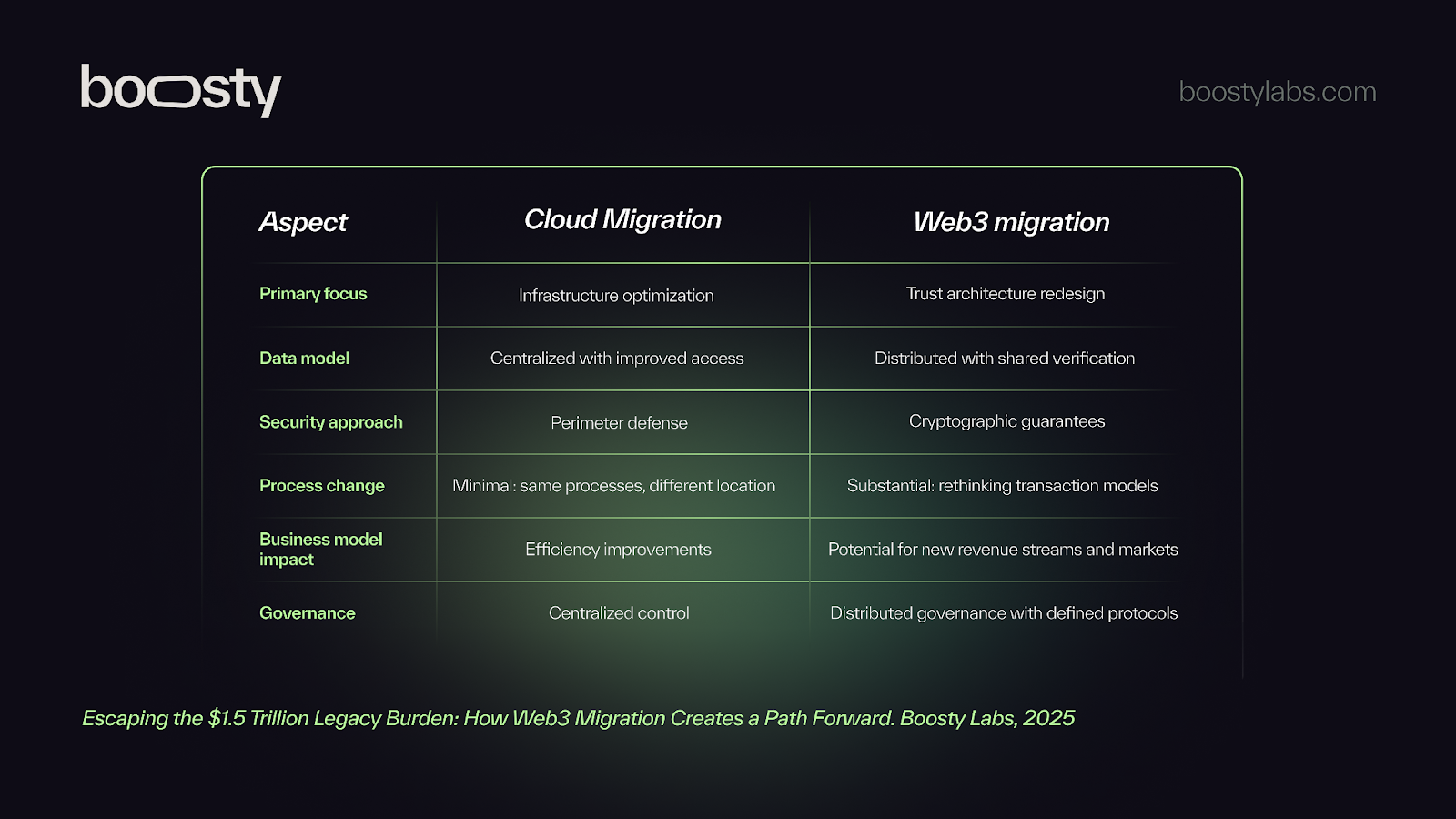
Companies that approach cloud migration strategically, rather than just “lifting and shifting” existing problems, gain competitive advantages. The same strategic thinking applies to Web3 but with potentially more significant differentiation for early adopters who reimagine processes rather than simply transplanting them.
Practical Challenges and Solutions
The path to Web3 integration presents specific challenges:
Technical Integration
Legacy systems weren’t designed for blockchain integration. Solutions include:
- Middleware platforms that are specifically designed to translate between traditional and blockchain protocols.
- Hybrid cloud approaches that provide connectivity while maintaining security boundaries.
- Containerization to isolate legacy components while enabling gradual replacement.
Governance and Compliance
Web3 architecture introduces new governance questions. Forward-thinking organizations are:
- Establishing clear decision frameworks for on-chain vs. off-chain processes.
- Working with regulators to define compliance approaches for blockchain-based operations.
- Creating new audit mechanisms appropriate for decentralized systems.
Organizational Readiness
Perhaps the most significant barriers are human and organizational:
- Skills gaps between traditional and blockchain development.
- Business processes that are designed around centralized control.
- Cultural resistance to decentralized models.
Leading companies are addressing these challenges through dedicated innovation teams, strategic partnerships with Web3 specialists, and executive education programs focused on blockchain applications.
Strategic Questions for Decision Makers
As you consider your organization’s approach to Web3, several questions become crucial:
- Which business processes would benefit most from decentralization?
- What data in your organization has the most significant value potential if made interoperable with Web3 systems?
- Where does blockchain technology solve existing pain points in your customer experience?
- What competitive advantages emerge from being early in your industry to adopt specific Web3 capabilities?
- How might your business model evolve if intermediaries were removed from key transactions?
The answers will be unique to your organization, but the exploration process is increasingly essential for maintaining competitive relevance.
About Boosty Labs
Boosty Labs is a premier blockchain development company with broad tech expertise and 150+ highly skilled developers and strategists on the team.
Founded in 2017, Boosty Labs has completed 250+ projects and collaborated with Fortune 500 companies and industry giants, such as Ledger, Consensys, Near, WalletConnect, MoonPay, and Storj.
Follow us on LinkedIn and X to stay connected.