

AgroTech: AI in Agriculture & Farming


What Can AI Do in Agriculture?
The argument in favor of the massive introduction of AI technologies in agriculture is often formulated as follows: the human population will reach 10 billion people by 2050, it is impossible to radically increase the cultivated areas, it is necessary to increase the intensity of their use. Imposing on farmers the task of feeding the entire population of the globe is like asking medium and small technology companies to solve the problem of global warming. At the moment, producers and consumers agree on one thing – the desire to make quality agricultural products more affordable. Are modern technologies able to solve these purely utilitarian questions?
By AI technologies, although in the strict sense, artificial intelligence is unlikely to appear in the foreseeable future, we will mean, for ease of classification, a set of solutions in the field of machine learning and Big Data processing, neural networks, machine vision, and so on. In the context of the use of AI in the cultivation of grains, vegetables and fruits, and animal husbandry, there are three key areas of how this can work in theory in principle:
Early Detection of Pests, Diseases and Weeds
Problem. Today, farmers manually inspect each section of their field for “malfunctions”, visually inspect the condition of the herd. There may simply be a lack of resources and experience to detect diseases at an early stage.
Solution. A drone equipped with computer vision that regularly monitors the plot (change in color of a leaf or ear can serve as a signal) or herd (changes in weight can be monitored).
Example: Salmon farms in Norway use stereoscopic cameras for early detection of sea lice disease in fish. The disease causes hundreds of millions of dollars in losses every year. The Norwegian government plans to make the technology an industry standard.
Precision Farming
Problem. Farmers apply fertilizers and irrigate with a continuous carpet, although areas of the same field may have different conditions, topography, soil composition: that is, somewhere there will be a shortage of resources, and somewhere there will be an oversupply.
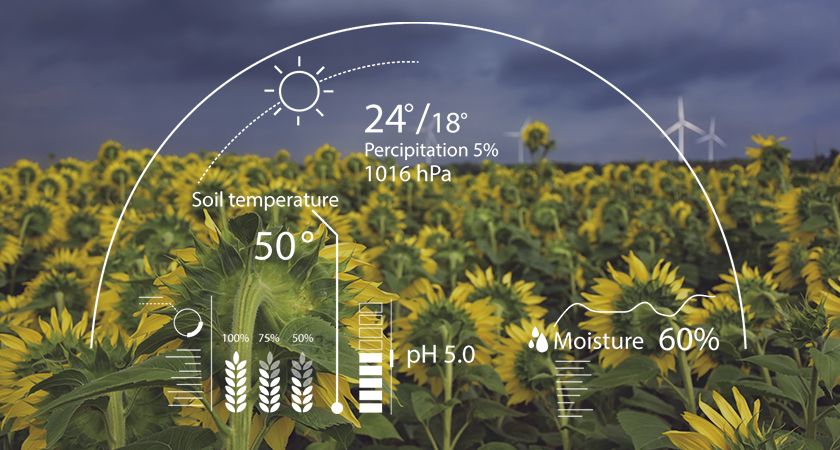
Solution. Sensors connected to the Internet of Things (IoT) network monitor the main indicators: soil moisture, temperature, site illumination, which are necessary for optimal farming. The algorithm makes recommendations for each square meter of the field, which leads to savings in water, seeds and chemicals.
Example. Several “AI farms” are located in China’s Guizhou province, which has cheap labor and a climate that allows machines and data centers to operate without expensive cooling systems.
Yield Calculation
Problem. It is extremely difficult for farmers to predict the result of their efforts to grow grains, vegetables or fruits year by year, especially when it comes to introducing new varieties, pesticides and so on. In general, many factors affect the yield.
Solution. Information collected by sensors or drones is analyzed by machine learning algorithms that operate, among other things, on historical data on climate change, field maps are created, and patterns are identified. As a result, the farmer can calculate the yield from each plot and even the change in the price of his products, optimize the use of resources.
Example. Digital platform for precision farming in Argentina. The system uses machine learning, drone and satellite geodata, and cloud computing to develop recommendations for farmers in real time.
Urban farming can be singled out as a separate example. An Israeli tech company used AI algorithms to find optimal lighting and humidity conditions to grow agricultural products in small home containers.
What Else Is the Evidence That This Is Implemented and Working?
There are very few cases of application of AI technologies by farmers in open sources. Almost all information comes from the developers of such solutions in the context of their potential.
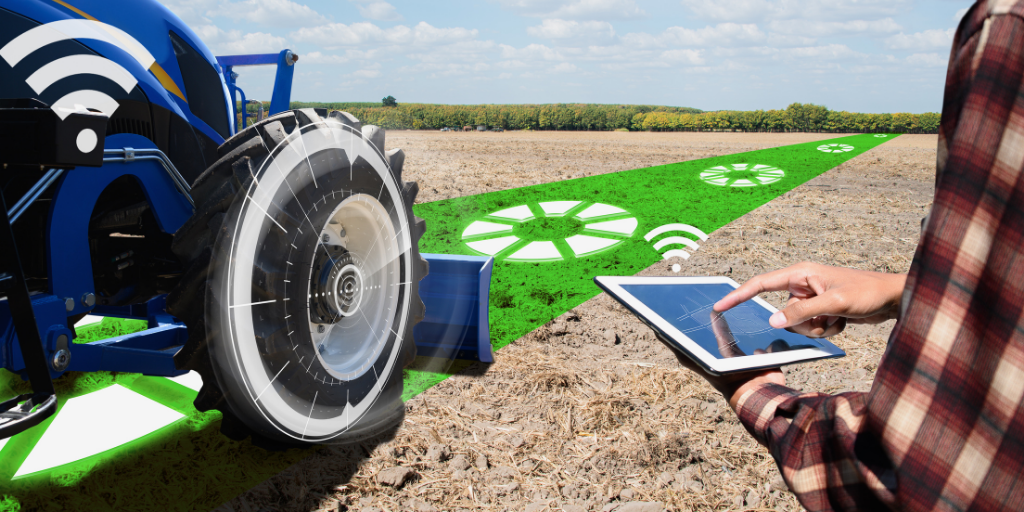
Let’s take a step back: from AI algorithms to simple automation. Fully automated, with minimal human intervention, plowing fields and harvesting grain does not seem like a difficult solution. The trajectory of movement here is simple and clear. All that the driver of the equipment does when preparing the field is a U-turn. There are no obstacles in the form of other vehicles or people.
The first concept of a fully autonomous tractor (without an operator in the cab) was released by CNH Industrial in 2016 in two versions at once. So far, there is no information about the launch of production and the mass introduction of the model in agricultural complexes.
John Deere, the largest manufacturer of agricultural equipment in the United States, which also already presented the concept of a tractor with an autopilot at one of the exhibitions, only in August 2021 announced the creation of a startup called Bear Flag Robotics, which is going to bring the technology to perfection. In fact, the company admitted that there is nothing similar on the market now.
Agricultural drones drive market growth
With the world’s population projected to exceed 9 billion by 2050, agricultural consumption is expected to grow by 70%, and drones have now become the mainstream of smart farming, helping farmers with a range of tasks, from analysis and planning to actual sowing crops, and subsequent field monitoring to determine health and growth.
Drones equipped with hyperspectral, multispectral or thermal sensors are able to identify areas that require a change in irrigation regime. Once the crop has started to grow, these sensors can calculate their vegetation index and AI health score by measuring the heat signature of the crop.
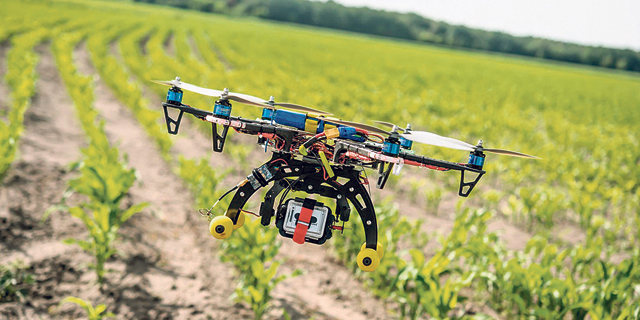
Nobody likes the idea of spraying chemicals, but for now, it’s a necessary part of large-scale farming.Fortunately, smart agricultural drones are helping to reduce environmental impact. Specialized UAVs (unmanned aerial vehicles) are equipped with atomizers with various technologies, such as ultrasonic echo devices and lasers, which can measure distance with extreme accuracy. The result is a significant reduction in total spray and a much lower level of chemicals entering the groundwater.
Agrobotix LLC is a drone software company that provides high-quality images and data analysis for sustainable and precision farming and supports more than 53 crops, including corn, grapes, apples, sugar cane, etc., for sustainable and precision farming in 50 countries. AgEagle Aerial Systems (the firm that acquired Agrobotix LLC) plans to develop new products using new technologies such as weather data, advanced image recognition and accurate analysis to provide better advice to farmers/consumers using them.
In terms of the development of AI technologies in agriculture, we are talking about the point use of sensors and drones in experimental farms. These are isolated examples across the industry. It is too early to talk about the widespread introduction of such solutions by farmers.
Objective Obstacles
The interest of farmers in the latest technical solutions in agriculture is still there. For example, large agricultural complexes in China during the period of the spread of African swine fever tried to introduce machine vision to identify and isolate sick individuals. The problem is that small farms, which are the majority, simply cannot afford it yet.
AI technologies for the mass agricultural producer are expensive and redundant. Rural areas have cheap labor. Plus, there is a social context: to free even those few workers, replacing them with robotic technology, is a social problem.
In addition, the growth in yields does not make farmers and agricultural complexes richer, it simply leads to a collapse in purchase prices from intermediaries. In such a situation, it is difficult to find an incentive to introduce costly innovations. Despite the fact that the farmer, as a rule, does not have free funds that could be invested in large-scale technical re-equipment.
The objective obstacle is that in agriculture there is a really long cycle of hypothesis testing and development of new technologies. At an experimental enterprise, in a field laboratory, it is difficult to simulate conditions that would be suitable for other regions, with a different climate, humidity, topography, and soil composition. The implementation of AI-based solutions requires basic technical and digital equipment. Connecting sensors to an IoT network simply requires stable high-speed Internet coverage. Data must be processed and stored somewhere. This means that you need to look for computing power or build your own local data centers.
Widespread adoption of technology carries its own risks. Training one such system is an energy-consuming process. According to experts, it leaves a carbon footprint equivalent to 284 tons of CO2. That is, the launch of one AI system will cost the planet five times “more expensive” than the contribution to global warming of one car.
AI should not be viewed as a “silver bullet” for solving all the global problems of the industry. But this is one of the promising areas, certainly worthy of attention.
ChatGPT in the Agricultural Sector: Advantages and Opportunities
ChatGPT is an innovative solution that allows you to create a chatbot that can have a dialogue, search for errors in the code, compose poetry, write scripts, and even argue.
ChatGPT was trained on a large array of texts from the Internet, as well as using a reinforcement learning system based on human feedback: Reinforcement Learning from Human Feedback. The neural network has undergone multiple retraining to make its answers even more accurate and correct.
The main goal of creating ChatGPT was to make artificial intelligence as easy to use, correct and “human” as possible.The system provides ample opportunities to automate various processes, reduce error reduction and improve work efficiency.
ChatGPT has many features and skills:
- Generation of phrases, sentences or entire text blocks that can be useful when creating content for websites or advertising.
- Requesting answers to questions based on the training information on which the neural network was trained.
- Help in solving problems, for example, by formulating a specific problem and suggesting possible solutions.
- Generating various content, including advertisements, social media posts, news articles and other types of text.
- Automatic completion of sentences and phrases in applications when the user enters text into a search box or when writing emails.
- Creation of various kinds of chatbots that can help in customer service: answer questions, learn about customer preferences or make recommendations.
- Extracting information from texts, as well as identifying the most important information in the text.
These are just some of the features of ChatGPT and its analogues. Developers can use this technology to create innovative applications that not only save time and resources, but also provide a deeper understanding of user needs and preferences.
What does ChatGPT think about its application in agriculture?
We have asked ChatGPT how it sees itself in agriculture, and this is what we came up with:
- Automation of reporting and documentation generation. ChatGPT can create automatic reports on the status of crops and crops, generate accounting reports and other documents, which can significantly reduce the time and resources spent on such tasks.
- Improve communication between farmers and consumers. With ChatGPT, you can create chatbots that will shorten the chain of communication between farmers and consumers. This allows customers to ask questions about growing methods and product quality, and farmers to receive feedback on their products and services, which will help improve the quality of products and change the way they are produced.
- Weather forecasting and vegetation management. ChatGPT algorithms can be used for weather forecasting and crop management. This requires collecting data on weather, soil moisture, pests, and other parameters, and then using this data to create models that help predict the best time to plant or harvest, as well as the most effective pest control methods.
- Recognition of patterns and organic materials. ChatGPT algorithms can be used for pattern and organic material recognition, which helps determine which labels are needed for each package and which shipping method is the best.You can also use ChatGPT to detect irrigation system leaks and other technical problems.
For many of the ChatGPT agricultural use cases that it has generated, you need to seriously refine the neural network or use it as an addition to an existing development.
One application that appears to be the most realistic is to improve communication between farmers and consumers. Creating chatbots that allow farmers and consumers to communicate will enable buyers to ask questions about growing methods and product quality, and farmers to receive feedback on their products and services, which will help improve the quality of products and change the way they are produced.
Most people are suspicious of ChatGPT technology because of the possible receipt of false information, lack of responsibility and the impossibility of direct interaction with physical processes. There are people who see the benefits of using ChatGPT in the agricultural sector. With proper refinement, such a neural network will be useful in creating and filling out documentation. Or it will use the approach of an offline AI assistant that can combine data from the Internet, as ChatGPT-plus does with their plugins.
There are those who have not yet figured out this technology and believe that the agricultural sector does not need new technologies, but only working hands.
The opinion on the possibilities of using ChatGPT in the agricultural sector is ambiguous. Most people are skeptical about this technology, but there are those who see its benefits.The use of ChatGPT in the agricultural sector requires more careful study. ChatGPT is one of the AI systems that can be used in the agricultural sector for processing and analyzing text data and creating chat bots. However, it must be taken into account that ChatGPT may not give completely plausible answers, which can lead to errors in decision making. Thus, when using a neural network, you need to be careful and check the information using other sources.
In addition, ChatGPT cannot be trained on its own database, which can be a limitation in its use in some business areas. This problem can be partially solved by using open-source models, but with a high degree of probability they will not be able to provide the desired quality. In general, the use of ChatGPT in the agricultural sector can improve the efficiency and productivity of the region.
Conclusion
The market for artificial intelligence (AI) in agriculture is driven by the growing adoption of robots in agriculture. Growing consumption and the growing need to increase crop yields are fueling the demand for robots in agriculture. Precision farming is in demand as it is believed that around 70-80% of new equipment purchased contains some form of precision farming tool along with the demand for smart green applications.
Farmers control almost half of Europe, making agriculture the dominant industry in Europe. The trend towards monitoring and reporting tools for indoor and outdoor farms, as well as the visualization of a farmer’s entire production using computer vision and artificial intelligence, is increasing the AI market in agriculture. Row crops are being grown with AI in various countries in Europe, where the robot uses 20 times less herbicides due to its accuracy when weeding row crops.
The European Soil Data Center (ESDAC) is a thematic soil data center in Europe that aims to be a single point of reference and store all relevant soil data and information at the European level. AI firms operate the “Internet of Soil” which is a software and hardware solution for monitoring soil conditions such as moisture, temperature, electrical conductivity and more in European countries. Their sensors connect wirelessly to a cloud platform where they can be accessed by any device connected to the internet.
Berlin-based InFarm has developed a vertical indoor farming system using IoT, big data and cloud analytics that can be implemented in supermarkets, restaurants, local distribution warehouses or even schools, allowing businesses to grow their own fresh produce locally for delivery. clients.The company is already opening indoor farms in 1,000 locations in Germany and expanding to other European markets, increasing AI’s share of the agricultural market.
Yield maximization through machine learning techniques is the driving force behind the market. Species breeding is the tedious process of finding specific genes that determine water and nutrient efficiency, climate change adaptation, disease resistance, and nutrient content or better taste. Machine learning, in particular deep learning algorithms, requires decades of field data to analyze crop performance in different climates, and from that data a probabilistic model can be built that will predict which genes are most likely to contribute to a beneficial plant trait.
The rise in adoption of cattle face recognition technology is driving the market. Through the use of advanced metrics, including bovine facial recognition programs and image classification combined with body condition assessment and feeding regimens, dairy farms can now individually track all aspects of behavior within a group of cattle.The increase in the use of unmanned aerial vehicles (UAVs) on agricultural farms is driving the market as the use of drones in the agricultural industry can be used to scan fields with compact multispectral image sensors, create GPS maps with onboard cameras, transport heavy payloads, and monitor livestock with drones with thermal imaging cameras, which increases the demand for UAVs.
There are about 1,300 startups in the “agriculture and farming” direction on the Crunchbase list. Global spending on smart technologies in agriculture, systems based on artificial intelligence by 2025, according to forecasts, should grow to $15.3 billion. The costs of farms only on technical solutions with artificial intelligence will grow to $4 billion in 2026 (data Markets & Markets). However, the lack of standardization is holding back the growth of the market, as the lack of standards in data collection and the lack of data sharing are high, and machine learning, artificial intelligence, and advanced algorithm development are advancing so rapidly, but the collection of well-labeled, meaningful agricultural data is far behind.
Soon, Boosty Labs will provide services for the implementation of artificial intelligence solutions in the field of agriculture and farming.