

Build vs Buy vs Partner: The New Reality of Web3 Development in 2025


Fortune 100 companies launched 39% more cryptocurrency, blockchain, and Web3 initiatives in Q1 2024 compared to 2023, reaching a record high. At this point, it’s safe to say that blockchain has proven its business value beyond speculation.
Yet many organizations still struggle with the fundamental question: Should we create our own blockchain solution, purchase a ready-made platform, or work with blockchain experts? Each option involves different trade-offs in speed, cost, and customization. Read on to quickly evaluate each approach and determine which path makes the most sense for your situation.
Build: Complete Control with Corresponding Costs
Building your own Web3 infrastructure gives you complete control over your blockchain implementation. This approach works best for organizations with requirements that off-the-shelf solutions can’t satisfy.
For instance, JPMorgan Chase & Co. (JPM) built Kinexys (previously Onyx) from scratch at the end of 2020 as part of the bank’s Web3 development strategy. Kinexys is one of the world’s first bank-led blockchain platforms for “transforming the way money, information, and assets move globally.” Why? Because they needed complete control over their blockchain implementation to meet their specific requirements.
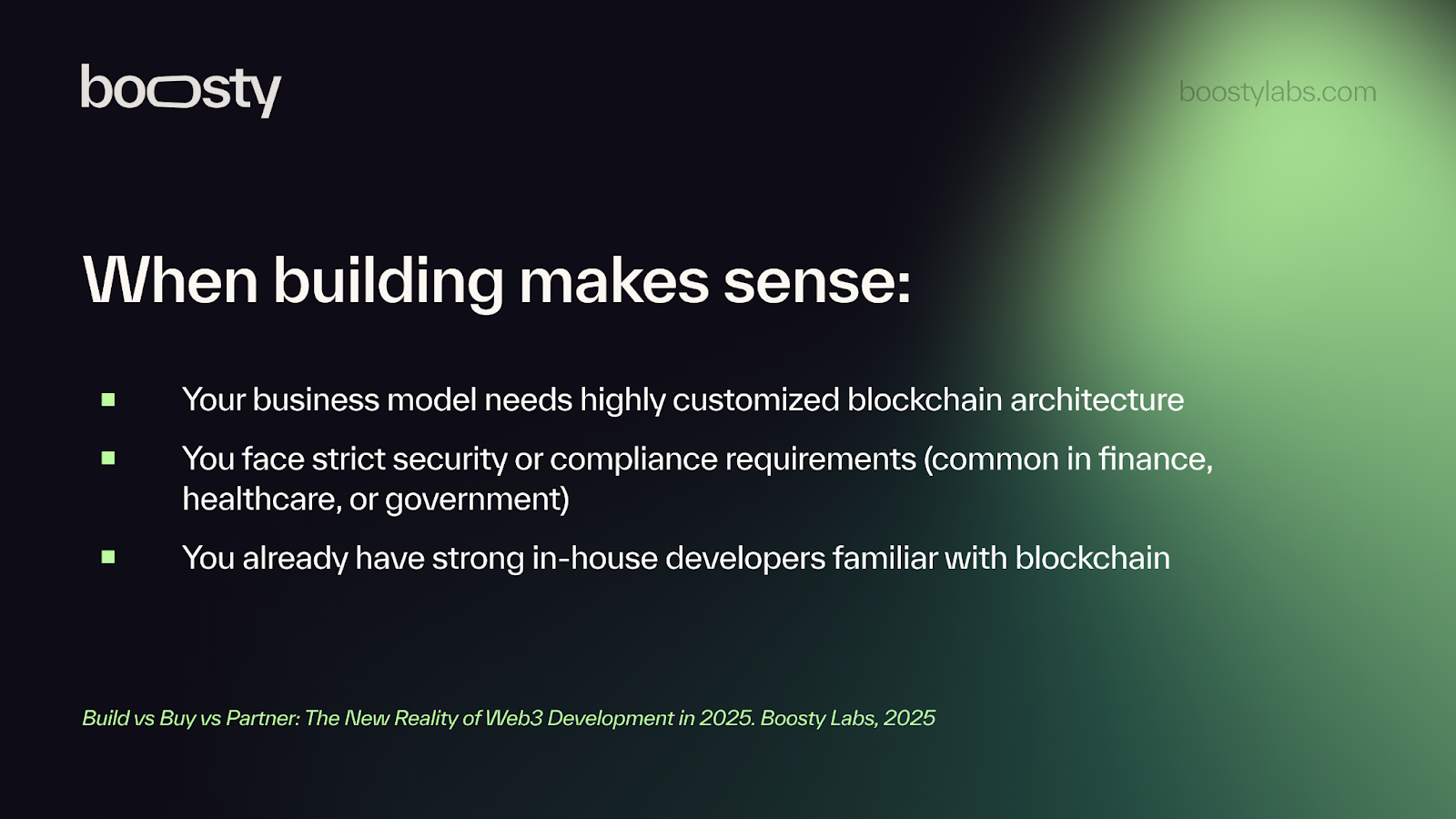
However, the challenges are substantial. Blockchain developers remain scarce and expensive. The technical complexity goes beyond basic coding — successful implementation demands deep knowledge of cryptographic principles, consensus mechanisms, network architecture, and more.
Companies choosing this path should expect longer timelines. Most blockchain projects built from scratch take 9-12 months before production deployment, with costs that scale with complexity. You’ll also need ongoing maintenance, security updates, and adaptation to constantly changing standards.
Buy: Speed to Market with Standardized Solutions
The growth of blockchain-as-a-service (BaaS) platforms has made “buying” a viable option. This approach focuses on speed rather than customization, letting businesses implement blockchain without developing deep technical expertise.
An example of such collaboration is Nestlé and Carrefour joining the IBM Food Trust — a blockchain platform that connects participants across the food supply chain through a permissioned, permanent, and shared record of food system data.
In 2019, the companies partnered to allow consumers to access information about the Mousline instant mashed potato supply chain by scanning a QR code on the packaging with their smartphones. This three-way partnership, involving Nestlé, Carrefour, and IBM, was implemented within six months.
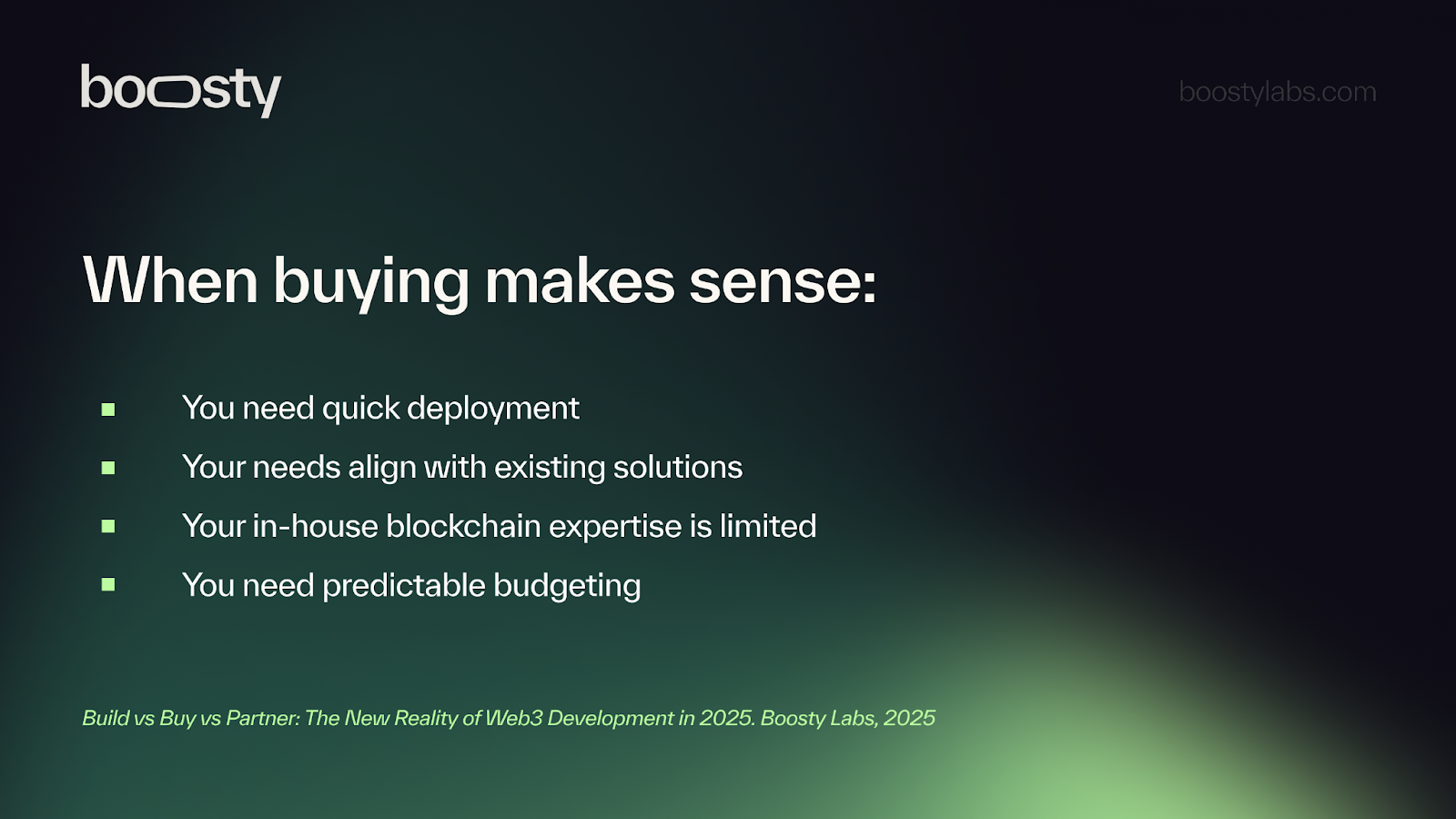
The trade-off is flexibility and differentiation. Off-the-shelf solutions often contain inevitable compromises, as they are designed for a broad range of customers rather than meeting your specific needs. Customization options exist, but they frequently hit roadblocks when fundamental changes are needed.
Integration challenges also arise when connecting these solutions to existing systems. What vendors promise as “seamless” integration often requires significant adaptation work, particularly with older systems.
Partner: Strategic Collaboration for Optimized Implementation
Working with specialized Web3 development firms has become the preferred strategy for many companies in 2025. This approach combines the customization benefits of building with the expertise advantages of buying.
For instance, in 2021, Ledger decided to launch Ledger Market on a mission to “power the NFT revolution and enable a future where users, creators, and brands interact with their digital value while keeping full control and sovereignty over it securely.”
Settling for existing solutions and customizing them wasn’t an option since one of the key features of the NFT marketplace had to be the world’s first secure “clear-signing” mint process.
Building from scratch also wasn’t viable, given the team’s active involvement in other processes. So, Ledger partnered with Boosty Labs, a team with 7+ years of blockchain experience who’d built several NFT platforms before, to develop Ledger Market. This partnership resulted in ~300% instant ROI and crazy sales numbers, which you can learn more about in the Ledger x Boosty Labs case study.
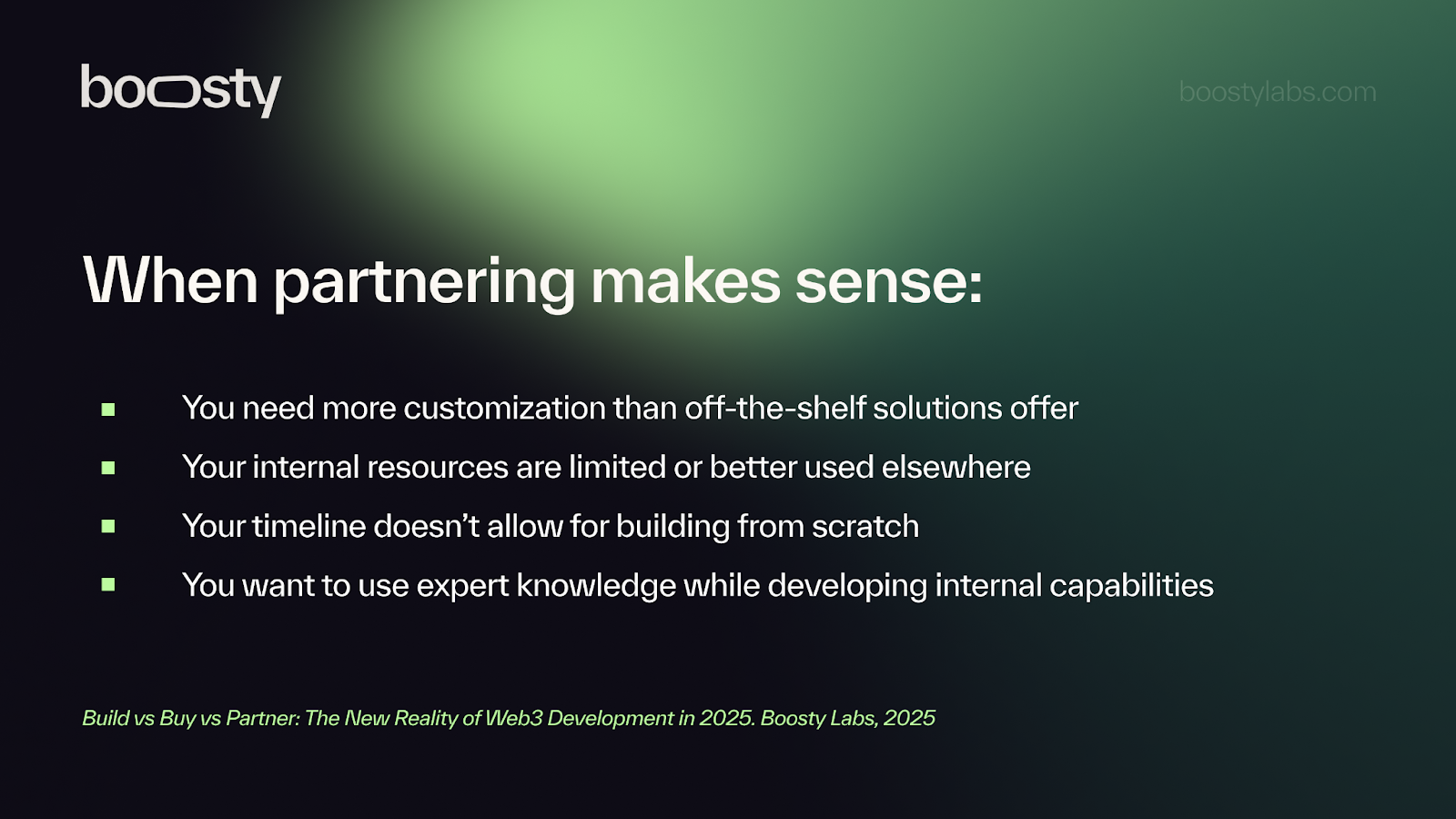
Strategic partners bring technical skills and valuable industry knowledge. A good blockchain development partner guides you on which features deliver real business value, helping you avoid costly over-engineering. Development agencies with blockchain expertise, like Boosty Labs with its 150+ developers and strategists, provide flexible resources that can adjust as project needs change.
The partnership model also transfers knowledge, with external experts training your team throughout development. This fills the talent gap while building your internal capabilities.
Decision Framework: Evaluating Your Organization’s Needs
When deciding which approach fits your organization, consider these key factors:
- Strategic value: How vital is blockchain to your competitive advantage?
- Timeline needs: How quickly must you implement?
- Available talent: Do you have the necessary expertise in-house?
- Customization needs: Will standard solutions meet your requirements?
- Budget structure: How do you prefer to allocate capital or operational expenditures?
- Ongoing support: Who will maintain the solution after launch?

The build-buy-partner framework. Source: A primer on Web3 adoption for enterprise, Deloitte
Most organizations prefer hybrid approaches rather than committing to either extreme, likely balancing the need for standardization with customization requirements.
Globally, 40% of organizations primarily use off-the-shelf tools with some built-in-house components, making it the most common approach. Pure strategies are less popular, with only 16% exclusively using off-the-shelf tools and 11% solely building their own.

Source: The State of Enterprise Blockchain Adoption in 2023, Casper Labs
Key Considerations When Selecting a Protocol
Beyond the build-buy-partner decision, you must also choose which blockchain protocol will form the foundation of your solution. Key factors include:
- Scalability: Different protocols offer varying transaction speeds and fees
- Industry adoption: Which platforms have similar companies chosen in your field?
- Developer community: Strong developer communities indicate ongoing support and innovation
- Integration capabilities: Ability to connect with your existing systems and financial processes
The proper protocol choice depends heavily on your specific use case, including financial transactions, supply chain management, or digital asset creation.
The takeaway
The path to successful Web3 implementation begins with an honest assessment of your organization’s capabilities, needs, and strategic priorities. Start by identifying and evaluating your core business requirements against the tradeoffs we’ve discussed. Engage key stakeholders early in the process, from IT and operations to finance and legal.
Remember that your initial implementation approach can evolve—many organizations that partner or buy solutions eventually transition to building their own as they develop expertise. The most crucial step is to begin your blockchain journey with clear objectives and realistic expectations.
About Boosty Labs
Boosty Labs is a premier blockchain development company with broad tech expertise and 150+ highly skilled developers and strategists on the team.
Founded in 2017, Boosty Labs has completed 250+ projects and collaborated with Fortune 500 companies and industry giants, such as Ledger, Consensys, Near, WalletConnect, MoonPay, and Storj.
Follow us on LinkedIn and X to stay connected.
Sources:
- https://www.coinbase.com/blog/the-state-of-crypto-the-fortune-500-moving-onchain
- https://proveai.com/blog/the-state-of-enterprise-blockchain-adoption-in-2023
- https://www2.deloitte.com/us/en/pages/consulting/articles/blockchain-and-web3-adoption-for-enterprises.html