

Institutional Crypto Adoption in Japan, Q1 2025


While preparing the article on institutional crypto adoption, we raised the following questions:
- Is there any reason behind institutional crypto adoption in Japan with a focus on Bitcoin? Or is it just the influence of the worldwide Bitcoin mania sparked by Michael J. Saylor and Trump’s statements?
- Why now? Why not last year or the year before, but specifically during Q4 2024 – Q1 2025?
We’re going to cover each question with numbers and facts, so let’s dive deeper
Major institutional crypto moves in early 2025
In Q1-Q2 of 2025, Japanese banks, investment firms, and corporations accelerated their cryptocurrency initiatives, focusing mainly on Bitcoin. By May 9, 2025, Tokyo-listed Metaplanet Inc. had accumulated 6,796 BTC, having added 5,034 BTC since the beginning of the year. The firm financed these acquisitions through equity and bond issuance.
- Total Bitcoin holdings were acquired at an average price of $86,000, amounting to a ¥46.9B (~$432.9M) investment.
- The company publicly outlined a strategy (“21 Million Plan“) aiming for 10,000 BTC by year-end and 21,000 BTC by 2026 — directly mirroring U.S.-based MicroStrategy’s model of using Bitcoin as a corporate reserve asset.

Metaplanet’s move had market consequences: stocks rose over 1,000% YoY, and it is now the largest public Bitcoin holder in Asia, as well as a top-10 corporate holder globally. Other publicly traded Japanese firms also maintained crypto treasuries, though none at Metaplanet’s scale.

For context, Nexon Co. has held ~1,717 BTC since 2021, and internet conglomerate GMO Internet holds digital assets via its mining business – but these were legacy positions, with no major increases reported in Q1 2025.

Financial institutions concentrated on crypto investment products and infrastructure rather than holding crypto on balance sheets. Let’s go through the core points:
- Sumitomo Mitsui Financial Group (SMFG), Japan’s second-largest bank, partnered with @AvaLabs and @FireblocksHQ to launch a fiat-pegged stablecoin issuance platform. A pilot program is scheduled for H2 FY2025.
- A group of financial institutions (Mitsubishi UFJ Trust, Nomura, and Daiwa) formed a coalition advocating for Bitcoin and Ethereum ETFs in Japan.
- Asset manager SBI Holdings partnered with Franklin Templeton to establish a joint venture (51% SBI, 49% Franklin) aimed at launching Bitcoin ETFs domestically.
- Nomura’s digital asset subsidiary continued expanding fund offerings, including:
- A Bitcoin fund (launched in late 2023);
- An Ethereum fund offering a staking yield (~5.5%) for structured portfolio allocation (1–5%).
- Traditional banks are more focused on other options instead of Bitcoin: Japan’s “megabanks” – MUFG, SMBC, and Mizuho – continued piloting stablecoin-based cross-border payments (Project “Pax”) using a blockchain platform MUFG’s Progmat instead of correspondent banking. Project scope provided below.


By late Q1 2025, regulators approved the first foreign stablecoin USDC for circulation in Japan, with SBI’s crypto exchange arm leading the rollout. Exposure beyond Bitcoin realizes primarily in the form of stablecoins (for payments and settlements) and to a lesser extent Ethereum (through proposed ETFs and fund products).
Japan’s approach to blockchain adoption should not be misinterpreted as technological hesitancy.
- The United States and European Union experienced a 3-5 year gap between retail cryptocurrency enthusiasm and meaningful institutional participation. Even Singapore and South Korea, with their technology-forward policies, saw 2-3 year delays between consumer interest and corporate implementation. So while many markets begin with widespread consumer adoption before institutional integration, Japan’s enterprise-first approach provides a more stable foundation for sustainable growth
- This foundation is already taking shape through stablecoin initiatives, such as the previously mentioned SMFG partnership with Ava Labs and Fireblocks. And stablecoins typically serve as the entry point for traditional financial systems into blockchain ecosystems
- Japan creates conditions for potentially accelerated implementation once fundamental frameworks are established through institutional adoption
Japanese non-institutional investors have slightly different preferences:
- Bitcoin remains dominant, comprising 65% of all crypto held on Japanese exchanges.
- Interestingly, XRP accounts for 18% of holdings, outpacing Ethereum’s 14.4% share, indicating a divergence in asset preference between institutions and retail participants.

Macroeconomic drivers in Q1 2025
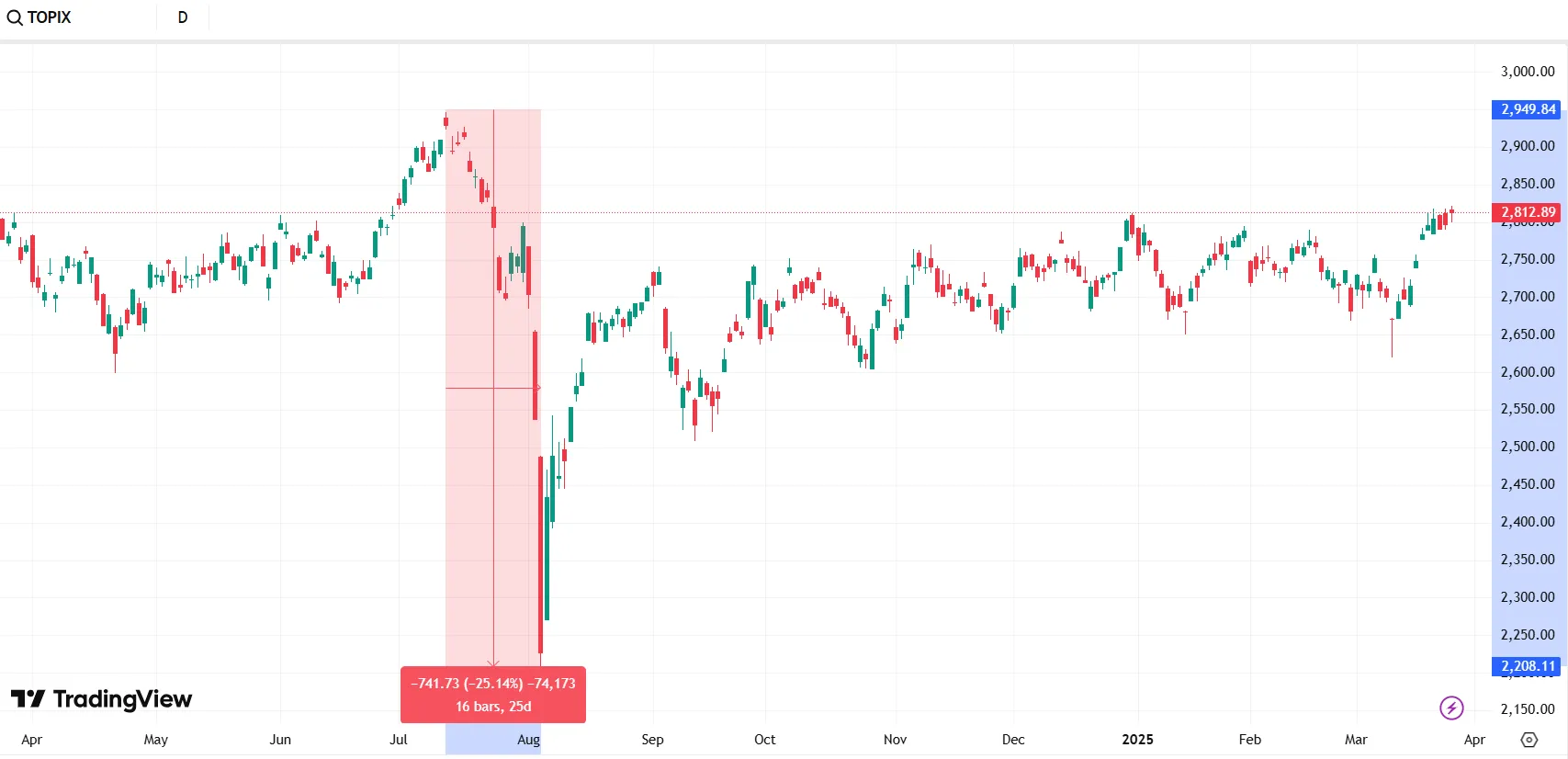
In July 2024, Japan did something it hadn’t done in nearly two decades: raised interest rates. The Bank of Japan moved its policy rate from -0.1% to 0.25%. That might sound like a small change, but for markets used to near-zero rates for 17 years, it was a big deal.
The hike led to a significant appreciation of the Japanese yen, affecting the export-driven economy. Consequently, the Tokyo Stock Price Index (TOPIX) declined more than 25% within the following month.
So what happened?
Before the rate hike, many investors used carry trades: they borrowed cheap yen and invested it in higher-yielding U.S. assets — stocks, treasury bonds, equities, even crypto. Once rates rose, this play became expensive. Investors unwound those positions, selling off U.S. and crypto assets to repay their yen-denominated loans.
We explained it in simple terms, so it’s a good time to join DARC and not miss such a simple explanations of all this “hard macro everything.”
The stronger yen reduced the competitiveness of Japanese exports, leading to downward revisions in earnings forecasts for major exporters. This, coupled with uncertainties surrounding global trade dynamics, has heightened market volatility. Investors reacted by reducing exposure to equities, particularly in sectors sensitive to currency fluctuations, such as automotive and electronics.
Despite the interest rate increase, Japan’s inflation picked up significantly – headline CPI reached ~4.0% in January 2025 (the highest in two years) and fell to 3.7% in February. This value remains well above the Bank of Japan’s 2% target and even about 1% higher than U.S. inflation.
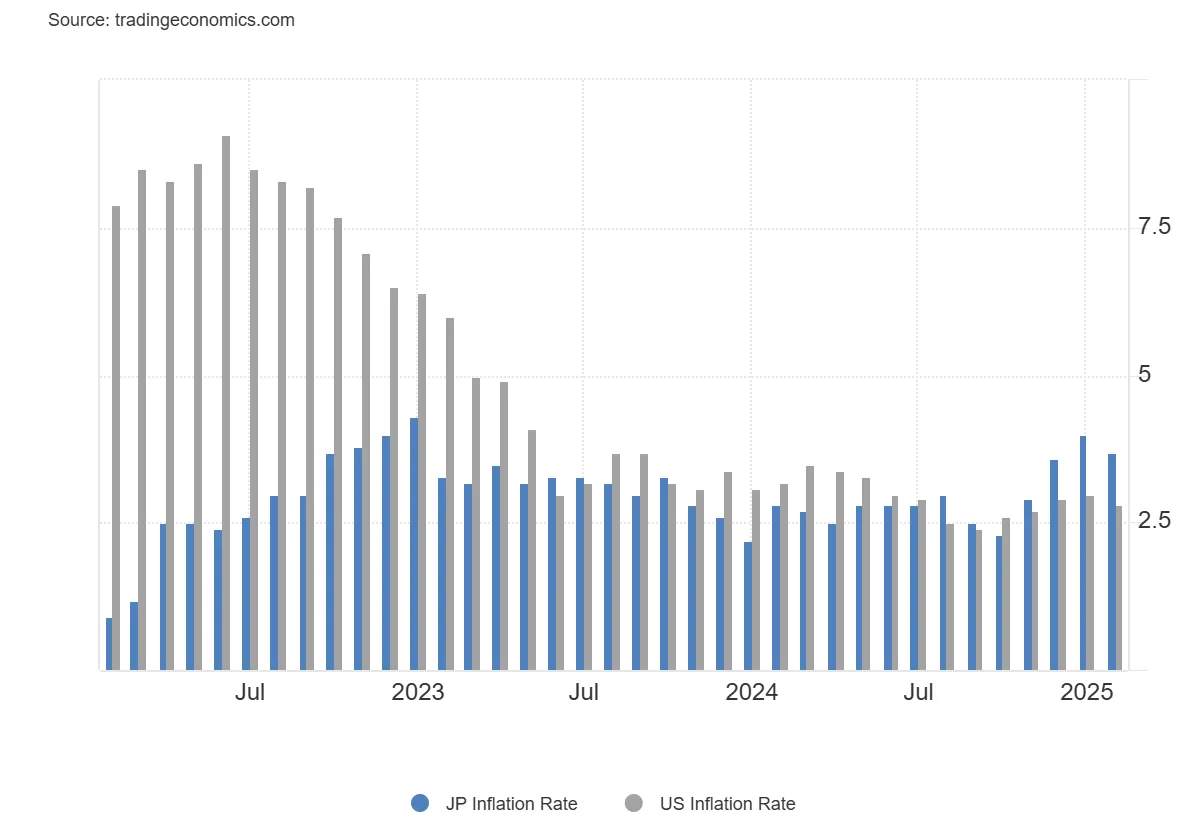
Yet, nominal interest rates are still very low. The BoJ’s policy rate was only 0.5% and 10-year government bond yields stayed around ~0.6–1.5%. The result is deeply negative real interest rates – cash and bonds lose purchasing power after inflation.

The Japanese yen traded at multi-decade lows against the U.S. dollar in late 2024 (breaching ¥150 per $1), and while it stabilized in early 2025, confidence in the yen’s strength remains low. Japan’s public debt (over 250% of GDP) and ongoing fiscal stimulus contribute to expectations of longer-term yen weakness.
So what’s the play when cash erodes, the yen weakens, and inflation eats returns? For some institutions, it was Bitcoin.
Japanese corporations with high yen-denominated liabilities see Bitcoin as a form of currency hedge: if the yen falls, Bitcoin (priced in yen) tends to rise, offsetting some losses.

Expectations that the BoJ might tighten policy further (to cope with inflation) created uncertainty in traditional markets. The mix of possible higher interest rates but still expansive fiscal policy put institutions in a difficult spot. Many kept large cash reserves but feared both inflation (eroding cash) and market volatility from policy shifts. Allocating a small portion to Bitcoin was seen as a strategic hedge in case of policy missteps – if inflation runs hotter or yen slides, Bitcoin could provide an uncorrelated upside.
Regulatory and supervisory landscape (Q1 2025)
Japan’s regulatory stance toward crypto in Q1 2025 was mostly supportive:
- Japan moved to cut crypto capital gains tax from 55% to 20%, matching stock and forex rules.
- Lawmakers proposed treating crypto as its own asset class, instead of miscellaneous income.
- Since 2022, trust banks have been allowed to custody crypto under FSA rules, giving institutions a legal, secure way to hold digital assets. In practice, major banks have set up trust subsidiaries to handle digital asset custody under these rules.
However, regular commercial banks are still generally prohibited from directly offering crypto trading or custody services (they must use affiliates or partners due to the Banking Act constraints).

Japan’s updated Payment Services Act (effective June 2023) opened the door for yen or foreign currency-pegged stablecoins to be issued domestically by licensed entities. On March 24, 2025 the FSA approved Circle’s USDC as the first foreign stablecoin for use in Japan and for now the only one freely available.
“We are honored to bring USDC to businesses and consumers in this market. With the strong support of SBI Holdings and leading exchanges, USDC is set to be a secure and transparent digital dollar for Japan’s evolving digital economy” — Jeremy Allaire, CEO of Circle
“This initiative enhances digital asset accessibility and promotes financial innovation, aligning with our vision for the future of payments and blockchain-based finance in Japan” — Yoshitaka Kitao, CEO of SBI Holdings
SBI Holdings’ subsidiary was licensed to distribute USDC, and major exchanges like bitFlyer and Binance Japan moved to list it. The stablecoin framework requires full fiat backing and redemption at face value.
Boosty Labs perspective
In conversations with Japanese business representatives, Boosty Labs has noticed recurring themes in their blockchain inquiries. Healthcare is a frequent topic of discussion, with questions centered on data security and the preservation of privacy. We’ve similarly observed interest from representatives in the retail and fashion sectors, who seem drawn to exploring verification capabilities, although most remain in exploratory phases rather than implementing them.
Japanese organizations tend to express particular curiosity about decentralized identity frameworks and logistics applications during consultations.
Based on these interactions, we believe asset tokenization and fintech integration represent particularly promising pathways for blockchain development in Japan. These areas naturally complement Japan’s established financial infrastructure while addressing specific operational challenges that distributed ledger technology could potentially resolve.
DARC’s Rationale: Why Japanese institutions focus on Bitcoin
While some market spectators may see Japanese institutions as “Bitcoin focusing maniacs”, let’s review the real reasons behind their moves:
- From a local macro perspective, holding cash in yen today is like holding an ice cube — it slowly melts. That’s why Metaplanet’s CEO said Bitcoin is a “hedge against yen depreciation.” Companies with global operations or costs in dollars are especially exposed to this, and Bitcoin gives them a way to balance that risk.
Think of it this way: if you’re a Japanese company and you keep your savings in yen, you might be losing purchasing power. But if you hold Bitcoin and it goes up, it offsets that loss
Unlike holding cash (which earns near-zero interest) or JGBs, holding Bitcoin offers upside in an inflationary scenario. This hedging appeal is especially noted for firms with international operations or USD exposure, as Bitcoin can offset inflationary pressure in fiat currencies.
- From the portfolio diversification perspective, banks and corporations don’t want to put all their eggs in one basket. Bitcoin acts like a wild card — it doesn’t move like traditional stocks or bonds. So even if you just add a small amount, it can change your risk-return profile.Metaplanet isn’t the only one thinking this way. Globally, 48% of financial organizations now say crypto helps diversify portfolios. And with Japanese bond yields at just 1.53% (as of March 2025), companies are hunting for new sources of potential growth
Metaplanet is basically following a “MicroStrategy playbook” — use Bitcoin to increase company value over time. Not random hype, but a clear financial model
- From the current market and investors demand perspective, investors like companies that look forward — and crypto has become a way to signal innovation. Over 58% of financial firms now say their crypto strategy is helping their brand. Metaplanet’s example is hard to ignore: by shifting to a “Bitcoin-only” treasury model, its stock rose 1,700% in one year. Retail investors even started buying its shares through tax-free NISA accounts.
Another example? HK Asia Holdings bought just one Bitcoin — and its stock jumped 93%. That’s how strong the crypto signal is in this market.

- From regulatory perspective Japanese lawmakers have proposed recognizing crypto as a separate asset class (not just “intangible”), potentially allowing fair-value evaluation akin to securities. From a compliance standpoint, Bitcoin is the most established crypto asset with a well-tested custody infrastructure. Focusing on Bitcoin (and secondarily Ethereum) aligns with regulators’ comfort zone – a late 2024 industry study group advised limiting any initial ETFs to Bitcoin and Ether due to their track record.
In practice, institutions find Bitcoin simpler to justify internally than more speculative tokens, given its decade-plus history and recognition (some Japanese banks even classify Bitcoin in internal risk models similar to commodities)

Summary
In Q1 2025, Japanese institutions demonstrated an increase in cryptocurrency adoption, with Bitcoin at the forefront of their strategies. So, to highlight core info from mentioned above:
- Tokyo-based Metaplanet Inc. is the Asia’s largest public Bitcoin holder, with 5,034 BTC by May 2025, employing a “21 Million Plan” to secure 10,000 BTC by year-end and 21,000 BTC by 2026.
- Major financial institutions, including SBI Holdings and Nomura, focused on launching Bitcoin and Ethereum ETFs and other crypto investment products, rather than holding cryptocurrencies directly.
- Traditional banks such as MUFG, SMBC, and Mizuho advanced blockchain initiatives, including Project Pax for stablecoin-based cross-border payments, and facilitated USDC’s rollout as the first foreign stablecoin approved for circulation in Japan.
- Rising inflation, deeply negative real interest rates, and yen-to-dollar declining trend prompted institutions to view Bitcoin as a hedge against monetary risks and a portfolio diversification option.
- Japan’s regulatory landscape is remaining favorable, with proposals to reduce crypto capital gains tax from 55% to 20% and categorize digital assets as a distinct asset class.
The decisions made by Japanese institutions to prioritize Bitcoin in early 2025 reflect an adaptation to macroeconomic pressures and an evolving regulatory landscape. Focus on Bitcoin & stablecoins is just a more pragmatic approach to digital asset adoption. Institutions are trying to minimize risk exposure by choosing the most established and liquid asset and stablecoin-based infrastructure projects.
At AKINDO we see Japan’s institutional crypto adoption as a starting point. The real challenge is building long-term, ecosystem-native products — and that’s where our Buildathon model comes in. Unlike short-term hackathons, Buildathons help ecosystems create real utility by aligning incentives and supporting sustained development. Treasury strategies are just step one — real adoption comes when killer apps emerge. — Shinichiro Kinjo, Founder of AKINDO
Looking ahead, Japan’s blockchain ecosystem appears poised for significant evolution. What distinguishes Japan’s approach is the potential for compressed timelines. While other markets experienced years of fragmentation before institutional standardization, Japan’s methodical groundwork may enable more rapid scaling once core systems are validated.